
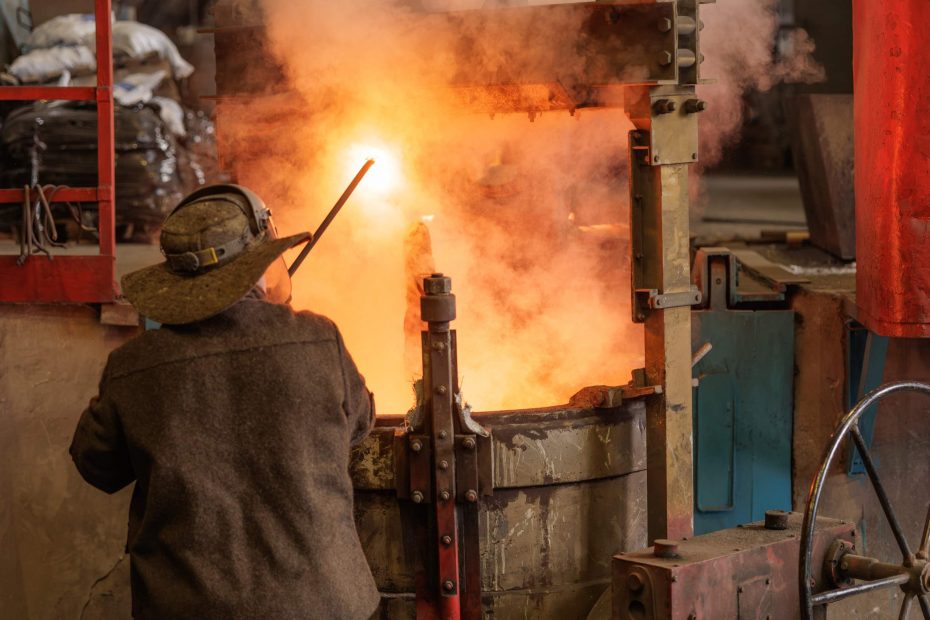
After molten metal fills the mold, the casting process reaches its most crucial phase. The metal starts to lose heat, harden, and form its microstructure.
Solidification takes place inside the mold, but it is far from a static stage. Factors like cooling rate, casting shape, mold materials, and alloy type dictate how the metal changes from liquid to solid casting.
The Start of Solidification
Upon contact with the cooler mold walls, molten metal begins to lose heat. Solidification typically initiates along the mold surface and advances inward towards the hotter center.
As the metal cools further, solid areas emerge and the remaining liquid metal migrates towards areas that solidify last.
This progression can have a significant impact on the resulting microstructure.
The Importance of Cooling Rate
The cooling rate affects the formation of structures within the metal.
Fast cooling may result in a different microstructure than slow cooling. These variations may affect mechanical properties such as strength, hardness, and toughness.
Therefore, cooling is not just about getting the casting to solidify as fast as possible. The goal is to maintain the right conditions for the given alloy and part design.
Influence of Casting Shape
Casting geometry dictates how heat is lost.
Thinner areas cool more rapidly than thicker areas, and large volumes may stay hot for longer. Different parts of a complex casting may solidify under different conditions.
Failing to account for these differences during design may lead to shrinkage, internal stresses, distortion, or other defects.
Shrinkage Phenomenon
Most metals take up less space once solidified than they do as liquids. This reduction in volume is called solidification shrinkage.
If extra molten metal cannot fill the void created by the shrinkage, cavities may appear within the casting.
Foundry engineers rely on carefully designed gating and risering systems to supply extra liquid metal to the casting during solidification.
Riser Design and Feeding
A riser is a pocket of molten metal connected to the casting. It provides additional metal to compensate for the contraction of the casting as it solidifies.
The riser’s placement and dimensions must be thoughtfully considered. It needs to stay liquid long enough to feed the parts of the casting that take longer to solidify.
Good feeder design can go a long way in preventing internal shrinkage defects.
Thermal Stresses and Cracking
Castings can cool and contract unevenly in different parts. When this movement is constrained, stress develops.
Under certain circumstances, this stress can cause distortion or cracking.
Casting geometry, alloy composition, mold conditions, and cooling rate all influence how severe these stresses might get.
Post-Solidification Cooling
Once the casting has completely solidified, cooling continues. The casting cools down until it reaches ambient temperature.
Cooling affects dimensional stability and the final condition of the material. Some applications call for post-casting heat treatments to alter the material’s properties.
It is important to consider the entire thermal history when assessing the quality of the casting.
Ways to Manage Solidification
The behavior of solidification can be managed through casting design, mold material choice, pouring parameters, feeding design, and cooling methods.
Software tools can also assist engineers in modeling the flow of molten metal and predicting where solidification will occur. This helps to identify problems before casting begins.
Conclusion
Solidification is one of the phases that affect the internals of a casting well beyond the time molten metal was poured. Cooling rate, shape, feeding, and thermal stresses may all affect the quality and performance of the final product.
A firm grasp of these factors can help foundry personnel make informed decisions about mold design, process planning, and defect prevention, which ultimately results in better, more consistent castings.